
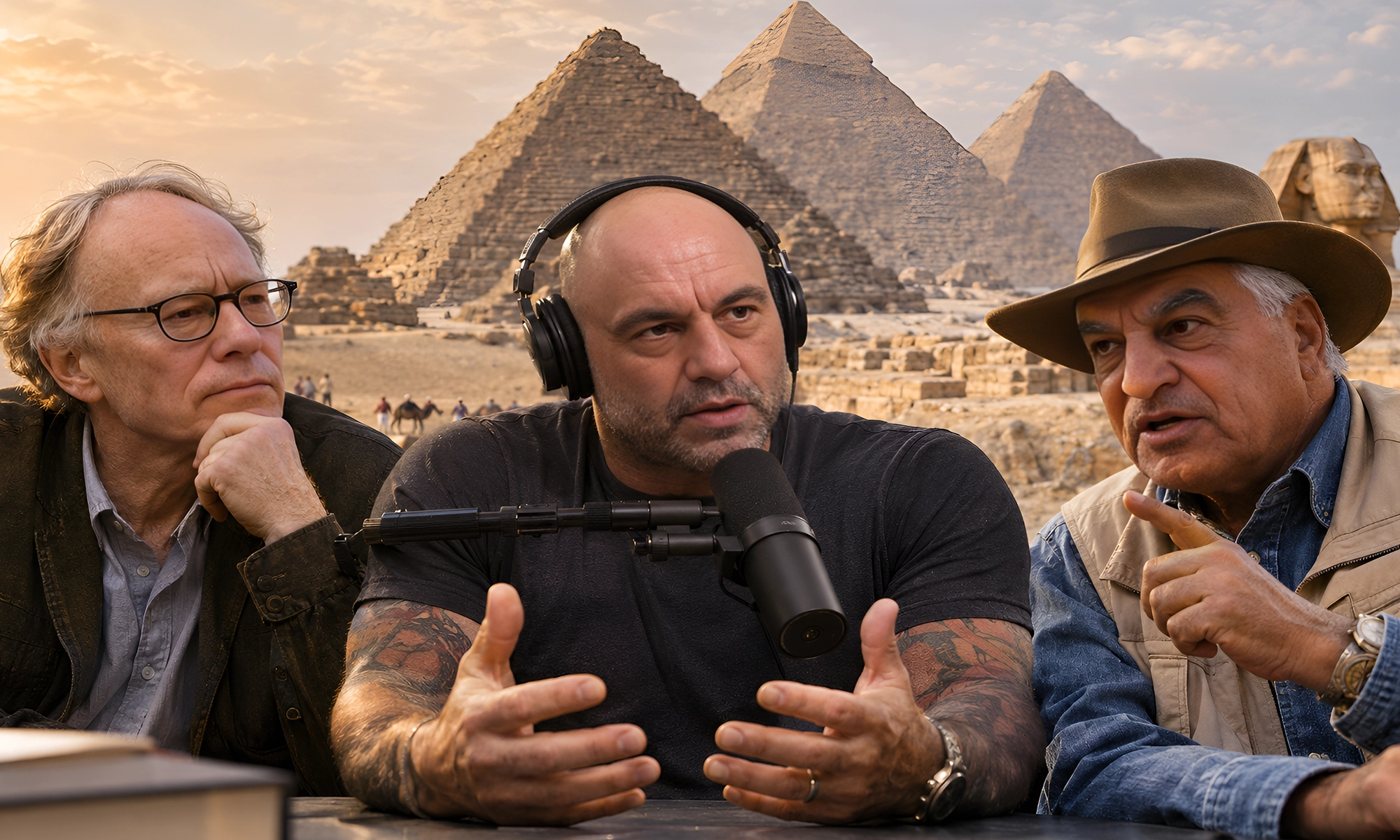
Few arguments on the internet have pulled in as many millions of listeners as the fight over who built the Pyramids of Giza. On one side stands Graham Hancock, the British author who argues that a lost Ice Age civilization left its mark on Egypt. On the other stands Dr. Zahi Hawass, Egypt’s former Minister of Antiquities, who has spent more than half a century digging at Giza. Between them sits Joe Rogan, the podcaster whose microphone turned an old academic quarrel into a global debate.
For more than 4,500 years, the Great Pyramid has stood on the edge of the Western Desert, silent while every generation argues over its secrets.
Through this article everyone will get to discover the full Hancock, Rogan, and Hawass pyramid debate: who these three men are, how the clash began, what happened on the two famous episodes of The Joe Rogan Experience, what the alternative theory actually claims, and what archaeological evidence says about the real builders of the pyramids.
Who Are the Three Men at the Center of the Pyramid Debate?
To understand the pyramid debate, it helps to know where each voice comes from. They are a journalist turned author, a comedian turned podcaster, and a field archaeologist turned public figure.
Graham Hancock: The Lost Civilization Author
Graham Hancock was born in Edinburgh, Scotland, in 1950 and studied at Durham University before working as a journalist. His 1995 bestseller Fingerprints of the Gods set out his core idea: an advanced civilization flourished during the last Ice Age and was wiped out by a global catastrophe.
In later books such as The Message of the Sphinx (1996, with Robert Bauval) and Magicians of the Gods (2015), he tied that catastrophe to the Younger Dryas, a sudden cold period that began about 12,800 years ago. His Netflix series Ancient Apocalypse brought these ideas to a new generation of viewers.
One point is often misunderstood. Hancock does not argue that aliens built the pyramids. His claim is that survivors of a lost human civilization passed knowledge to later cultures, including the ancient Egyptians.
Joe Rogan: The Podcaster With the Biggest Microphone
Joe Rogan hosts The Joe Rogan Experience, one of the most listened-to podcasts in the world. He has a long personal interest in ancient mysteries of Egypt and has hosted Hancock several times, including episodes #1897 and #2215.
Rogan presents himself as a curious outsider asking open questions. His critics say his platform gives fringe theories far more weight than the evidence supports.
Dr. Zahi Hawass: Egypt’s Most Famous Archaeologist
Zahi Hawass has served as Secretary-General of the Supreme Council of Antiquities and as Egypt’s Minister of State for Antiquities. He is known for decades of excavation at Giza and Saqqara, for leading the identification of the mummy of Queen Hatshepsut, and for campaigning to return Egyptian artifacts held abroad.
He is also a showman. His trademark hat has earned him the nickname “the real-life Indiana Jones,” a title he openly enjoys.
How the Pyramid Debate Began: 25 Years of Disagreement
The clash between Hancock and Hawass did not start on a podcast. In the 1990s, Hancock, Robert Bauval, and John Anthony West argued that the Great Sphinx and the Giza monuments were far older than Egyptologists accept.
Their case rested on two main ideas. The first was the Sphinx water erosion hypothesis, promoted by West and geologist Robert Schoch, which claims the Sphinx enclosure was worn down by heavy rainfall thousands of years before the pharaohs. The second was the Orion correlation theory, Bauval’s idea that the three Giza pyramids mirror the stars of Orion’s Belt as they appeared around 10,500 BC.
Hawass rejected both. He has pointed out that much of the Giza limestone is of poor quality and weathers quickly, which explains the erosion without any lost civilization. By his own account, he spent about 25 years debating Hancock, Bauval, and West.
The tension ran deep, yet it eventually softened. Shortly before the Rogan episode, Hawass said he had resolved this long dispute with Hancock, and reports say Hancock helped arrange the podcast interview about a year before it aired.
Round One: Graham Hancock vs. Flint Dibble on Joe Rogan
Before Hawass ever sat in the studio, the debate had a first act. On April 16, 2024, Joe Rogan hosted episode #2136, a debate between Graham Hancock and Flint Dibble, an archaeologist from Cardiff University.
The conversation ran for about four and a half hours. Dibble argued that archaeologists have surveyed the world in great detail and have never found the tools, settlements, crops, or waste that an advanced Ice Age civilization would leave behind. He cited huge site databases, such as about 171,000 recorded sites in the Horn of Africa region, to make the point that the record is not empty by accident.
Hancock replied that archaeology has missed whole chapters of the past before, that many Ice Age coastlines now lie underwater, and that mainstream scholars treat him unfairly. Opinions on who “won” split sharply along existing loyalties. Hancock returned to Rogan’s show for episode #2215 and accused Dibble of distorting key facts.
That debate covered the global theory. Egypt, and Giza in particular, would get its own showdown a year later.
Round Two: Zahi Hawass on The Joe Rogan Experience #2321
On May 14, 2025, The Joe Rogan Experience released episode #2321 with Dr. Zahi Hawass. The conversation lasted roughly two hours and covered the builders of the pyramids, their tools, the workers’ cemetery, and new scanning projects at Giza.
The tone was tense from early on. Rogan asked to see photos or online sources for several claims so that viewers could follow along, and Hawass often answered that the details were in his books. Hawass, cigar in hand, rejected each suggestion that anyone other than Egyptians built the pyramids.
One sharp moment came when Rogan raised the Italian radar study of the Pyramid of Khafre. Hawass dismissed it outright. He explained that the base of Khafre’s pyramid is cut from solid bedrock and that nothing like the claimed structures could exist inside it.
Across the episode, Hawass kept returning to one challenge. He said that if anyone showed him a single piece of evidence that the builders were not Egyptian, he would accept it immediately.
The Aftermath: The Worst Podcast Ever?
The fallout began almost at once. Rogan called it possibly “the worst podcast I’ve ever done,” while adding that it might also have been a good one. He described Hawass as a “closed-minded fellow” who had been “gatekeeping all the knowledge.”
A week later, Rogan was still mocking his guest. Speaking with Aaron Rodgers on his May 21 episode, he joked in a sarcastic tone that Hawass had “discovered everything, basically.”
Hawass answered just as firmly. In a July 2025 interview with the New York Post, he called it the worst interview of his life and said Rogan had not done his homework, comparing him unfavorably with Piers Morgan. He added that Rogan had declined his offer to tour the pyramids together and wanted to go with Hancock instead.
In Egypt, the episode sent Hawass’s name trending on X. Many Egyptians praised him for defending their heritage on a global stage. Others criticized him for interrupting, for leaning on his authority, and for not giving detailed answers to technical questions about construction.
The Khafre Underground City Claim
Much of the Rogan and Hawass clash circled one news story. In March 2025, Italian researchers including Filippo Biondi and Corrado Malanga announced that Synthetic Aperture Radar (SAR) tomography had revealed giant vertical shafts and “cylinders” reaching deep below the Pyramid of Khafre, which some outlets described as an underground city.
The findings had not been peer-reviewed. Hawass called the claim “fake news” and said no radar devices had ever been used inside the pyramid. He noted that the pyramid’s base was carved from natural bedrock to a height of about eight meters.
Other archaeologists raised a technical problem. Radar of this kind penetrates only a few meters into the ground under Giza’s conditions, far short of the hundreds of meters the researchers described. Without independent verification, the “city beneath the pyramids” remains an unproven claim.
What the Alternative Theory Actually Claims
It is easy to blur the different alternative ideas together, so it helps to separate them clearly.
- Graham Hancock’s lost civilization theory: An advanced human civilization existed during the Ice Age, was destroyed by the Younger Dryas catastrophe about 12,800 years ago, and its survivors passed on knowledge of astronomy and building.
- The older Sphinx idea: The Sphinx, or an earlier form of it, was carved thousands of years before the Fourth Dynasty, based on the water erosion argument.
- The ancient aliens idea: A separate theory, popular online, claims extraterrestrials built or helped build the pyramids. Hancock does not endorse it, though Hawass and many viewers often group the two together.
What unites these theories is a shared doubt: that a Bronze Age society with copper tools, ramps, and boats could have built monuments this large and precise.
The Evidence That Egyptians Built the Pyramids
The Ancient Egyptian society left behind more than stone; they left their names, their bread, their boats, and their graves. This is why Egyptologists are confident about who built the pyramids.
The Tombs of the Pyramid Builders
In 1990, a tourist’s horse stumbled over a buried mud-brick wall south of the Sphinx. Hawass, who was working nearby, identified it as part of the cemetery of the pyramid builders. Excavations since then have revealed hundreds of tombs belonging to workers, overseers, and artisans.
The tombs sit beside the royal pyramids and contain bread and beer offerings for the afterlife. Skeletons show signs of hard labor, such as arthritis and spinal damage, but also healed fractures that point to medical care. Hawass’s key argument is simple: slaves would not have been buried with such honor in the shadow of the king’s tomb.
The Lost City of the Pyramid Builders
American Egyptologist Mark Lehner has excavated a large settlement known as Heit el-Ghurab, or the “Wall of the Crow” site, about 450 meters south of the Sphinx. It contains bakeries, breweries, galleries for sleeping, and the bones of large numbers of cattle, sheep, and goats that fed the workforce.
Lehner and Hawass agree that a permanent core crew worked year-round, supported by rotating teams of laborers. Hawass estimates that around 10,000 workers a day labored for about 28 years to build the Great Pyramid as a national project.
The Diary of Merer
The strongest written evidence came to light in 2013. A French mission led by Pierre Tallet found the world’s oldest inscribed papyri at Wadi al-Jarf on the Red Sea coast, a port used under Khufu.
The best-preserved papyri, known as Papyrus Jarf A and B, are the logbook of an inspector named Merer. He recorded how his team of about 40 men hauled white limestone blocks from the Tura quarries and shipped them along the Nile and canals to Akhet-Khufu, “the Horizon of Khufu,” the original name of the Great Pyramid. The diary dates to around year 27 of Khufu’s reign.
Hawass has called the Diary of Merer the greatest discovery in Egypt in the 21st century. Parts of the papyri are now displayed at the Egyptian Museum in Cairo.
The Pyramids Themselves
The monuments also record their own evolution. Before Giza, Egyptian builders experimented with the Step Pyramid of Djoser at Saqqara, then with the Meidum Pyramid, the Bent Pyramid, and the Red Pyramid of Sneferu at Dahshur. These earlier attempts show mistakes, corrections, and steady learning over about a century.
The Great Pyramid, completed around 2560 BC, originally rose about 146.6 meters, built from roughly 2.3 million blocks. Quarry marks, workers’ gang names painted inside relieving chambers, copper tools, and remains of ramps all point to human builders working within a known timeline.
Weighing Both Sides: Where the Pyramid Debate Stands Today
The Hancock, Rogan, and Hawass pyramid debate is really two arguments in one. The first is about evidence. Here, mainstream archaeology holds a strong position: workers’ tombs, a builders’ town, a dated logbook, quarries, and a clear chain of earlier pyramids all show that Egyptians built the Giza pyramids during the Fourth Dynasty.
The second argument is about trust and style. Hancock’s supporters feel that experts dismiss new questions too quickly, and Hawass’s sharp manner on Rogan’s show reinforced that feeling for many viewers. Hawass’s supporters answer that extraordinary claims need extraordinary evidence, and that a confident tone does not make a fringe theory true.
Recent research shows that Giza still holds surprises. The ScanPyramids project used muon imaging to detect a large hidden void and a corridor inside the Great Pyramid, discoveries announced in 2017 and 2023. These findings came from peer-reviewed science and fit within the known history of the monument, which is exactly the standard both sides say they want.
Seeing the Evidence for Yourself at Giza
The best way to judge the pyramid debate is to stand in front of the evidence. At the Giza Plateau, you can walk around the Great Pyramid, look closely at the bedrock base of Khafre’s pyramid, and see the weathered body of the Sphinx that sparked the water erosion argument.
South of the Sphinx lies the area of the workers’ cemetery and the Wall of the Crow, where the builders lived and were buried. In Cairo, the Egyptian Museum displays fragments of the Diary of Merer, and a short trip to Saqqara and Dahshur shows the earlier pyramids that taught Egyptian builders their craft.
A licensed Egyptologist guide can connect these sites into one story, from the first stepped pyramid to the perfect angles of Giza.
Frequently Asked Questions About the Pyramid Debate
Does Graham Hancock believe aliens built the pyramids?
No. Hancock argues for a lost human civilization of the Ice Age, not extraterrestrials. Hawass and many online commentators often group his ideas with ancient alien theories, which is one reason the debate becomes so heated.
Which Joe Rogan episode features Zahi Hawass?
Zahi Hawass appeared on episode #2321 of The Joe Rogan Experience, released on May 14, 2025. The earlier archaeology debate between Graham Hancock and Flint Dibble is episode #2136, released on April 16, 2024.
Why did Joe Rogan call the Hawass episode his worst podcast?
Rogan said he felt uncomfortable during the conversation and described Hawass as closed-minded. He was frustrated that Hawass declined to show photos or online sources and often referred him to his books instead.
Who discovered the tombs of the pyramid builders?
The cemetery was found in 1990, after a tourist’s horse stumbled on a buried mud-brick wall south of the Sphinx. Zahi Hawass led the excavations, which uncovered tombs of workers, overseers, and artisans who built the pyramids.
Is there really a city under the Pyramid of Khafre?
There is no verified evidence of one. The March 2025 radar claims were not peer-reviewed, and experts note that this type of radar cannot see hundreds of meters into the ground at Giza. Hawass called the claim fake news.
Summary:
- Graham Hancock argues that a lost Ice Age civilization influenced Egypt, while Zahi Hawass insists the evidence shows Egyptians built the pyramids.
- Joe Rogan hosted Hancock against archaeologist Flint Dibble in episode #2136 (April 2024) and hosted Hawass in episode #2321 (May 2025).
- Rogan called the Hawass episode possibly his worst, and Hawass replied that Rogan did not do his homework.
- The March 2025 Khafre radar claims of an underground city were not peer-reviewed and were rejected by Hawass and other experts.
- Workers’ tombs, the builders’ town, the Diary of Merer, and earlier pyramids form the core evidence that Egyptians built Giza.
Every Debate Must Come to An End Or Is it?
The Hancock, Rogan, and Hawass pyramid debate shows how a 4,500-year-old monument can still divide millions of people. Hancock offers a bold story of lost wisdom, Rogan offers a stage for open questions, and Hawass answers with tombs, papyri, and decades of excavation.
The pyramids keep their silence, but the names of the men who built them, like Merer and his crew, still speak from the sand. For anyone curious about the truth, the clearest answer waits at Giza itself.